June 2026 Local Politics Review: Broadwater, Jefferson, and Lewis and Clark Counties
- Shawn White Wolf

- 8 hours ago
- 7 min read
by Shawn White Wolf
The Tri-County Postcard
June 2026 has been a reminder that local politics is not always loud, but it is always busy.
Across Broadwater, Jefferson, and Lewis and Clark Counties, the political conversation is being shaped by elections, growth, zoning, planning, public notices, public safety, infrastructure, and the never-ending question of how small communities pay for the services people expect.
National politics may get the television time, but local politics is where the potholes, subdivisions, budgets, ballots, water systems, and emergency plans actually live. That is where June has been interesting.
The June Primary Set the Table for November
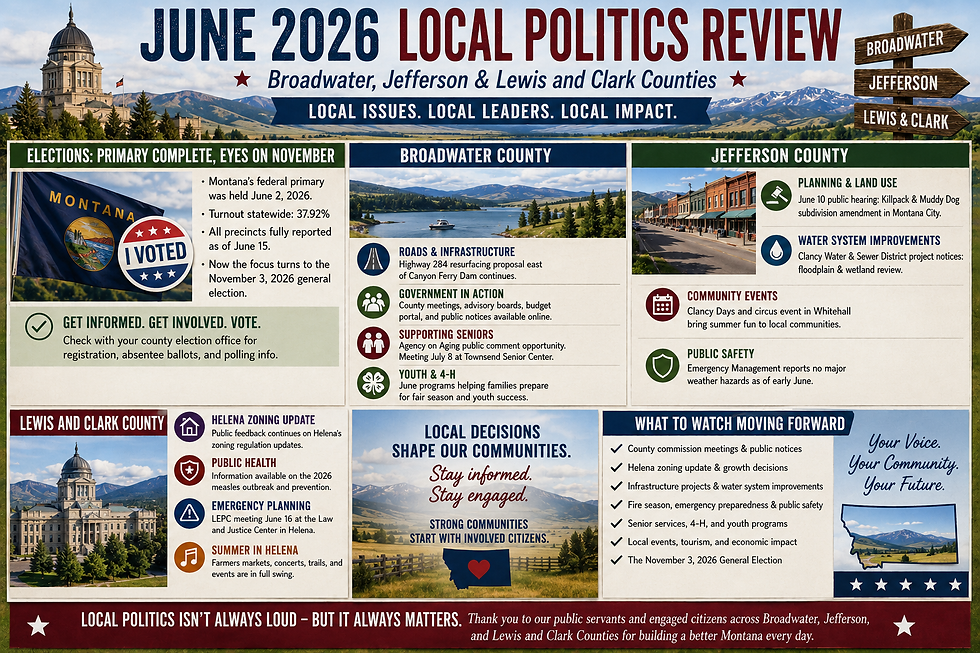
Montana’s federal primary election was held June 2, 2026. Across the state, voters chose party nominees for federal, state, legislative, and other offices. For local voters in Broadwater, Jefferson, and Lewis and Clark Counties, the primary was less the final answer and more the opening bell for the general election season.
The practical takeaway is simple: the November 3 general election is now the main event.
In Broadwater County, the election office lists the county as part of Congressional District 2, Senate District 39, and House District 77. The county election office also notes it maintains about 6,100 voters across five precincts. That gives Broadwater County a small but meaningful political footprint, especially in races where rural turnout matters.
Jefferson County voters are also now looking ahead to November, with county election resources available for precincts, polling places, absentee voting, and voter registration. Like many Montana counties, Jefferson County’s political identity is shaped by a mix of rural residents, small-town voters, commuters, landowners, and people watching growth carefully.
Lewis and Clark County remains one of the more politically important counties in the region because it includes Helena, the state capital, and a mix of urban, suburban, rural, and government-worker voters. It is not just a population center. It is a political weather vane.
The Republican Primary Showed Internal Tension
One of the bigger statewide stories from the June primary was Republican tension inside the party. Several incumbent Republican lawmakers lost their primaries, which shows that the fight inside the GOP is not just rhetoric. It is happening at the ballot box.
That matters locally because Broadwater, Jefferson, and Lewis and Clark Counties all sit in a political region where conservative voters are influential, but not always identical. There is a difference between courthouse conservatives, hardline activists, business-minded Republicans, libertarian-leaning voters, and traditional rural conservatives.
Those differences are not always obvious from the outside, but primary elections expose them.
For local readers, the question is not just which party wins in November. The question is what kind of Republican or Democrat shows up on the ballot. Are they practical? Are they ideological? Do they know the county roads, the local water issues, and the budget limits? Or are they just repeating national talking points with a Montana accent?
That is where voters need to pay attention.
Democrats Still Face the Rural Trust Problem
Democrats in Montana continue to face a hard reality: they must do better outside their comfortable circles if they want to win more races.
That does not mean rural voters are unreachable. It means rural voters are not likely to be persuaded by polished campaign language that sounds like it was drafted in a meeting room three states away.
In counties like Broadwater and Jefferson, Democrats need to talk plainly about roads, property taxes, veterans, agriculture, public lands, health care access, senior services, and federal funding. In Lewis and Clark County, Democrats may find more friendly territory in Helena, but even there, voters are practical. They want housing, infrastructure, safety, and affordability addressed with real plans.
The old political rule still applies: people vote for candidates they believe understand their lives.
That may sound simple, but campaigns forget it all the time.
Helena’s Zoning Update Is a Major Local Political Issue
In Lewis and Clark County, one of the most important political stories in June is the City of Helena’s zoning regulation update.
Helena launched the process in May and continued seeking public feedback in June. Zoning may not sound exciting, but it is one of the most powerful tools city government has. It affects housing density, neighborhood character, business development, parking, building rules, land use, and the future shape of the city.
This is where politics gets real.
Everyone says they want more affordable housing until the proposal is near their block. Everyone says they support growth until growth changes traffic, views, parking, or neighborhood feel. Everyone says they want local businesses until zoning makes it difficult to operate one.
Helena has to thread the needle: allow enough growth to keep the city livable and affordable, while protecting the character that made people want to live there in the first place.
That is not easy. But ignoring the issue is not an option.
Jefferson County Is Watching Growth Through Planning and Infrastructure
Jefferson County politics in June continues to center around planning, land use, infrastructure, and basic county services.
The county posted June meetings and planning notices, including a Consolidated Land Use Board agenda and a public hearing tied to the Killpack and Muddy Dog subdivision amendment. These kinds of items may not draw big headlines, but they shape how rural and semi-rural communities change over time.
Jefferson County also posted notices related to the Clancy Water and Sewer District Water System Improvements Project, including floodplain, wetland, and environmental review materials.
That is important because infrastructure is politics. Water systems, sewer lines, roads, bridges, and public works decide where growth can happen and where it becomes a burden.
The political challenge for Jefferson County is familiar: how to handle growth without losing rural character or overloading services. That is the kind of issue where nobody is completely happy, which usually means local officials are somewhere near the real problem.
Broadwater County Politics Remains Grounded in Roads, Boards, and Services
Broadwater County politics in June has been quieter than Helena’s, but quiet does not mean unimportant.
The county calendar includes meetings, advisory boards, public notices, planning items, and citizen resources. The county also lists a county budget portal, agenda and minutes access, and board opportunities. Those are the nuts and bolts of local government.
Broadwater County also has growth and infrastructure questions of its own. The Highway 284 resurfacing proposal east of Canyon Ferry Dam remains one example of how transportation, tourism, residents, and public spending all come together. Roads matter in a county where people travel real distances for work, school, services, recreation, and emergencies.
The county has also posted materials related to subdivision regulations and a draft Rural Improvement District procedure. Those are not flashy topics, but they matter. Rural improvement districts can affect how local improvements are financed, who pays, and how public needs are handled when growth spreads into areas that need better roads or services.
In plain English: these are the kinds of policies that eventually show up on someone’s tax bill.
Public Safety and Emergency Preparedness Are Political Issues Too
Public safety is often treated like a separate category from politics, but it is not. Sheriffs, emergency services, disaster planning, fire conditions, and public alerts all depend on budgets, staffing, leadership, and public trust.
Lewis and Clark County has emergency planning activity, including a Local Emergency Planning Committee meeting scheduled for June 16. Jefferson County posts emergency management and situation-report information. Broadwater County’s sheriff and disaster/emergency services resources remain central to public safety in a large rural county.
June is also the season when fire concerns start becoming more serious. Local governments have to balance recreation, agricultural work, burning rules, fire preparedness, and emergency response capacity.
The political question is whether local leaders are planning ahead or waiting until smoke is already on the ridge.
Senior Services Deserve More Political Attention
One issue that deserves more attention across all three counties is aging services.
Broadwater County posted information connected to the Agency on Aging public comment process, with a July meeting at the Townsend Senior Center. That may not sound like a political headline, but it absolutely is.
Senior transportation, nutrition, health access, in-home support, caregiver support, and rural aging services are central to keeping older residents in their communities. Counties with aging populations cannot treat this as an afterthought.
For a tri-county region with many older residents, this should be a bigger political issue. Candidates and officeholders should be asked directly what they are doing to support seniors who want to remain independent, safe, and connected.
Local Government Transparency Matters
One positive trend is that county and city websites are making more information available online: agendas, minutes, election information, public notices, meeting calendars, budget documents, and planning materials.
That is good, but here is the catch: public information is only useful if people can find it, understand it, and act on it.
Local governments should keep improving how they explain what is happening. A PDF buried three clicks deep may satisfy legal notice requirements, but it does not always serve the public well.
Good government should be understandable government.
Final Opinion: June Was About Practical Politics
The big story for June 2026 is that local politics across Broadwater, Jefferson, and Lewis and Clark Counties is practical politics.
It is not all red-versus-blue shouting. It is land use. It is zoning. It is voter turnout. It is county budgets. It is public safety. It is water and sewer systems. It is election administration. It is senior services. It is whether growth is managed or simply endured.
That is the politics that actually touches people’s lives.
As November approaches, voters should ask candidates less about slogans and more about competence. Can they read a budget? Do they understand rural infrastructure? Do they know how federal and state funding works? Will they show up after the election? Can they work with people they disagree with?
Those questions may not fit neatly on a campaign sign, but they matter more than the signs.
June gave us the opening act. November will tell us who voters trust to handle the next chapter.
Comments